Air-to-Air Heat Pumps are now Cheaper to run than Gas Combi Boilers
Welcome to Hamish James Associates (HJA) and the first newsletter on Carbon Reduction. In this newsletter, we discuss air-source heat pumps for heating and cooling.
Air-to-air heat pumps are now close to, and in some cases below, gas boiler running costs while adding summer cooling; the main practical questions are domestic hot water, space for storage, installer support, and whether off-peak electricity can improve the economics.
Summary: Are Heat Pumps Economic
This newsletter covers whether an air-source heat pump is now competitive with a gas boiler. The short answer is yes: heat pumps produce more heat per kW of electricity /£ than gas boilers do. They are cheaper for domestic hot water if used at night-rate electricity. But still need a DHW cylinder, which takes up more room than a combi boiler. The industry has solved, or is close to solving, that problem.
Or, in simple terms, a gas boiler at best will cost 7.33 pence per kWh, and a Daikin multi+ costs 5.8 pence per kWh.
Air-to-Air Heat Pumps: Heating, Hot Water and Comfort Cooling
For a typical London home, the question is less whether an air-to-air heat pump can work and more whether the running costs, domestic hot water arrangements, and installation practicalities make sense.
Cost of Running a Heat Pump
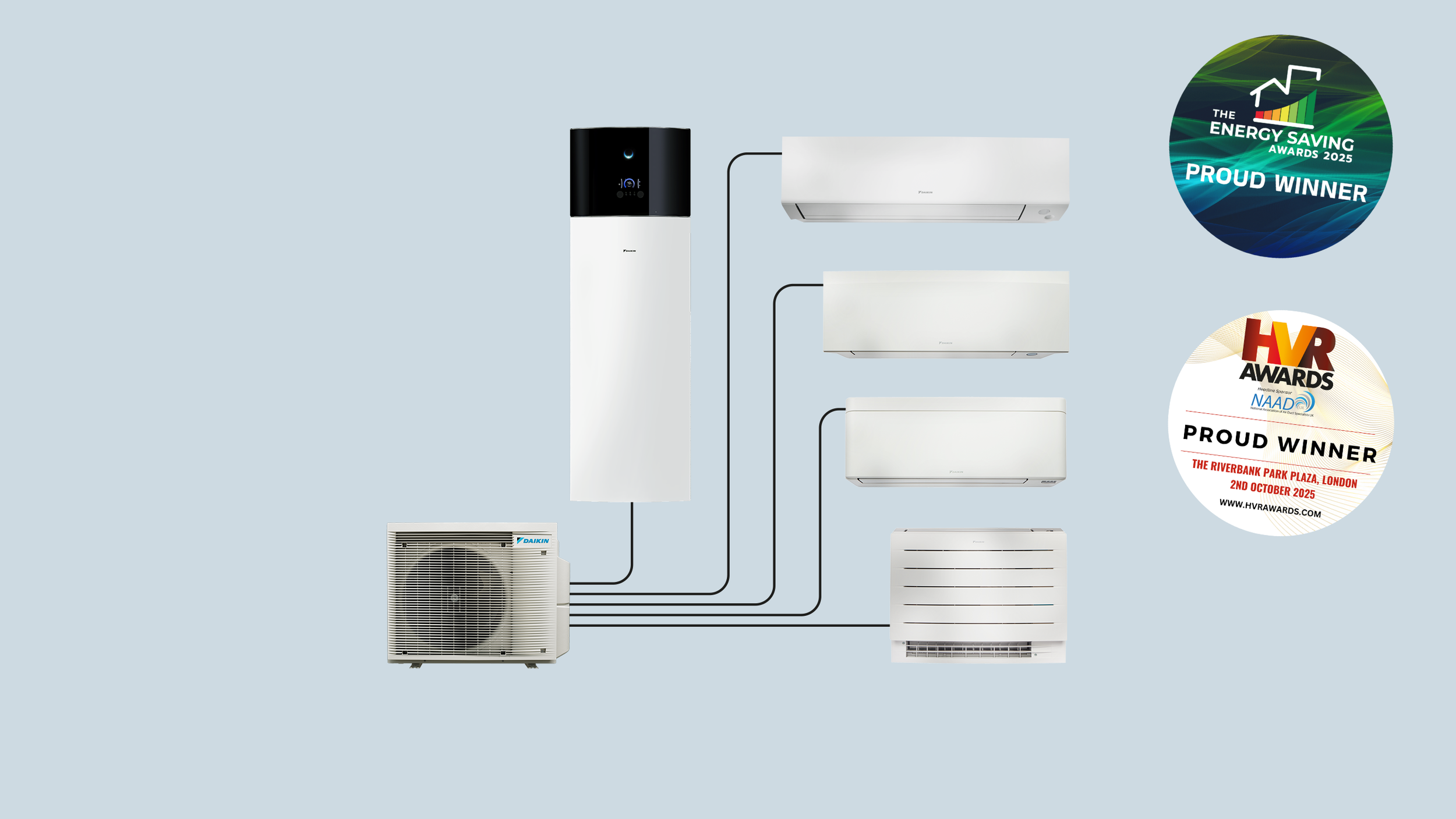
On current capped tariffs, electricity is about 3.56 times the price of gas per kWh, so a heat pump needs a seasonal SCOP above that figure to beat gas on running cost. Daikin’s Multi+ system is advertised as combining heating, cooling and domestic hot water, with high seasonal ratings for heating and cooling and hot-water tank options. SCOP of 4.6. So, it exceeds this by 21%. At worst, given the fact that no boiler is 100% efficient.
Allowing for grants, the capital cost may be only a few thousand pounds more than a boiler replacement, with the added benefit of comfort cooling with no radiators.
What is SCOP
SCOP is the key measure because it reflects seasonal efficiency: performance is better on milder days and falls in very cold weather. SCOP is a standard way to compare different models and brands of heat pumps' performance throughout a heating season.
Another score is how it performs on very cold days (Southeast England). Say -7oC—another standard temperature mark. In the case of the Daikin Multi+, it has a COP of 2.5 to 3.2. 2.5 would be worse for DHW. And 3.2 is probably for heating. So, it becomes more expensive than gas. But if you take advantage of Off-peak electricity at 12 pence per kWh compared to 24 pence per kWh, when very low external temperatures are likely to occur, the cost of heating is still lower than gas at 4.8 pence per kWh (Gas remains at 7.33 pence per kWh). But heating DHW during the day at -7 °C will be more expensive than a gas boiler.
Domestic Hot Water
One issue with air-to-air heat pumps is their ability to provide domestic hot water (DHW).
The awkward point has always been domestic hot water. Older air-to-air installations usually needed a separate solution, but newer systems such as Daikin Multi+ can connect an outdoor condenser unit with a DHW Cylinder, reducing that problem.
Heat Geek May Have A Solution
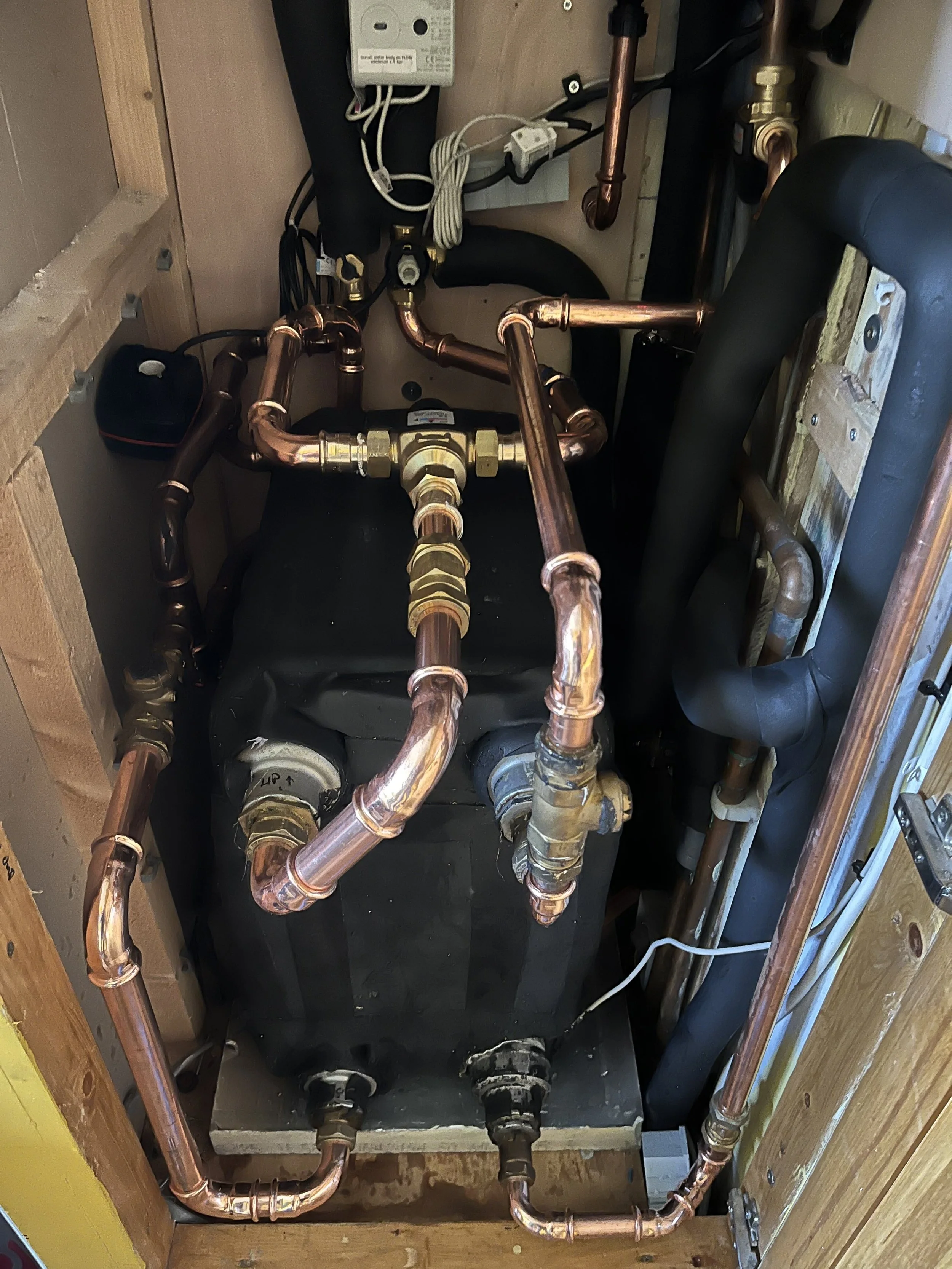
That still leaves the common combi-boiler problem: many flats and small houses have no cylinder cupboard. Heat Geek has been working on a heat exchanger plate that occupies the space of a combi boiler.
That still leaves the common combi-boiler problem: many flats and small houses have no cylinder cupboard. Heat Geek has been working on a heat exchanger plate that occupies the space of a combi boiler.
An alternative is compact thermal stores and phase-change products. These can fit under a kitchen corner unit. However, they weigh a lot—120 kg or more— and cost around £4,000 to £5,000. We are looking into the visibility of a heat exchanger unit for the Daikin Multi+ that will take up as much room.
And Free Summer Cooling
Heat Waves Comfort Cooling (Which appear to be becoming our normal Summers?)
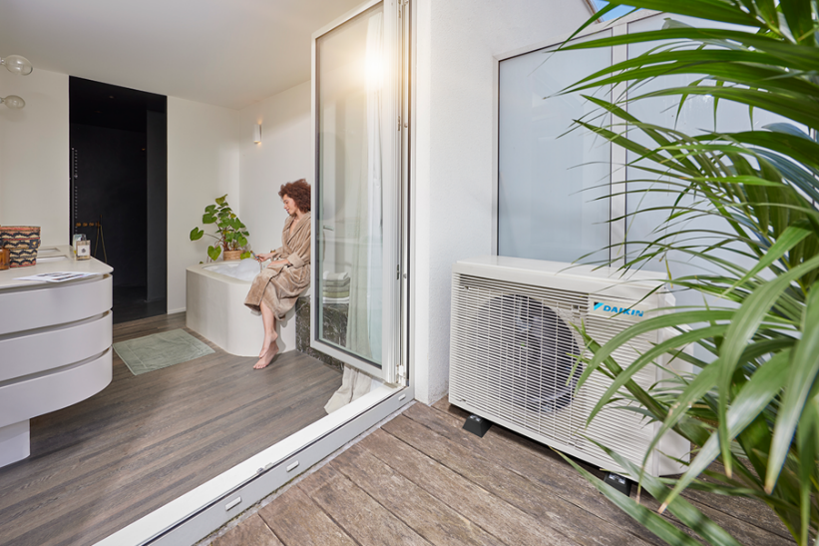
The big lifestyle advantage is summer cooling. Once the heat pump is installed for heating, the same system can keep bedrooms comfortable during heat waves, especially if cooling shifts to cheaper off-peak periods.
The trade-off is that electricity use moves into summer, so some theoretical heating savings may be exchanged for better sleep during hot nights.
Capital Cost
Overall, air-to-air heat pumps are now worth serious consideration for well-insulated homes with double glazing, especially where cooling is valued and where hot-water storage can be accommodated. The final decision should still be based on a proper design, tariff assumptions, cylinder or thermal-store space, and installer experience.
caveats
The right heat pump for your home or office depends on the property and your needs. Please get in touch if you would like help assessing the options. This newsletter provides general information, not professional advice. Each project needs its own assessment. Please see our website for more information